¿Por qué debo usar un antiespumante a base de agua?
Defoamer are industrial additives used to eliminate foam from industrial applications, helping prevent issues like hindered drainage and reduced paper quality. There are two different varieties: oil-based and water-based.
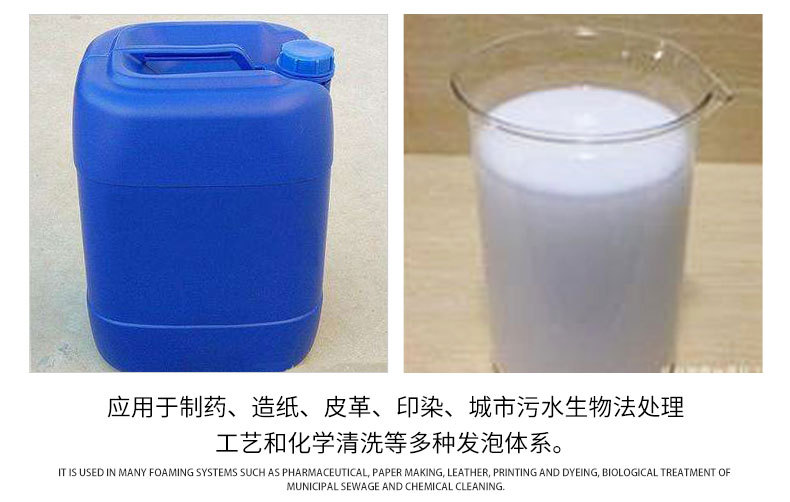
Water-based defoamers use water as their carrier phase and are classified as oil-in-water emulsions. They contain mineral oils or vegetable oils as the carrier phase, along with waxes like ethylene bis stearamide (EBSA) or paraffin waxes to boost performance.
Lower Cost
Water-based defoamers tend to be cheaper and simpler to use than their oil-based counterparts, without needing technical support to work efficiently.
Defoamers reduce the amount of foam produced in formulations, improving performance and decreasing quality issues. They can be applied using brushing, rolling, spraying or grinding; their choice will depend on your preferred coating method or application method.
Defoamer are typically made up of an emulsion composed of water-insoluble liquid hydrocarbon carrier and hydrophobic silica particles. The hydrocarbon carrier may include any liquid aliphatic, cyclic, or aromatic hydrocarbon such as mineral oil or vegetable oil as the carrier; additionally it may contain an emulsifier like ethylene bis-distearamide (EBD) or other surfactants to improve dispersion within the foaming medium. These heavy duty defoamers excel at knocking down surface foam while being great additions in powdered applications as they easily dispersion enhance dispersibility within foaming mediums.
Better Performance
Water-based defoamers offer more versatility and ease of use in papermaking environments of varying complexity, helping papermakers control foaming while optimizing drainage efficiency in production processes. They may be employed at various points within your pulp mill’s production cycle for maximum drainage efficiency and optimal control.
Water-based defoamers typically consist of a continuous phase and hydrophobic solid such as mineral oil or polydimethylsiloxane or fluorosilicone, along with surfactants to improve their emulsification and spreading in foaming systems, and inhibitors to protect them against degradation under harsh processing conditions.
Water-based defoamers contain defoaming agents that are easily dispersed throughout your foaming system, dissolving and dispersing their defoaming substance to rapidly reduce surface tension of foam liquid and cause it to break up and drain away quickly, dramatically improving drainage efficiency of papermaking systems while simultaneously lowering costs and improving sizing performance. Furthermore, they reduce foam build-up on thermal transfer lines which could inhibit their efficiency, ultimately improving drainage efficiency overall and saving costs as a result of better papermaking performance overall.
Broader Compatibility
Water-based defoamer can be designed with various chemical compositions to meet specific performance characteristics for various applications, such as shear stability and coating system compatibility to avoid negative side effects in the final paint film.
Defoamers work by quickly spreading out over foam bubbles, reducing surface tension and prompting their collapse – this reduces foam build-up in papermaking applications while eliminating unnecessary downtime for cleaning or maintenance services.
Selecting a suitable water-based defoamer for your production can save money and improve efficiency, eliminating downtime caused by excess foam to increase profits and secure competitive advantages. To get the most from your defoamer, it is also crucial to ensure its correct dosage and application; ensure it works with your papermaking process, chemicals used and meets regulatory guidelines governing paper industry usage; regularly monitoring will help fine tune dosage levels to achieve your desired results.
Environmentally Friendly
Defoamers that contain eco-friendly ingredients can help industrial processes reduce their ecological impact. Search for defoamers with biodegradable and low toxic levels as well as those meeting stringent environmental standards.
Water-based defoamers use water as their carrier phase and often feature hydrophobic solids such as silica or wax in an emulsified form so they can disperse easily into liquid media to effectively reduce foam and trapped air pockets.
Water-based defoamer are safer for workers to handle and less likely to interact negatively with other chemicals used in papermaking equipment lubricants or chemical additives. When selecting your defoamer, look for one manufactured using sustainable practices and using renewable energy; additionally consider those certified eco-friendly as additional assurance of ethical production practices.
 Spanish (Venezuela)
  English (United States)
  Arabic
  Bulgarian
  Czech
Czech  Danish
  German (Austria)
  German
  Greek
Greek  Spanish (Peru)
  Spanish (Colombia)
  Spanish (Spain)
  Spanish (Argentina)
  Spanish (Mexico)
  Spanish (Chile)
  Estonian
  Finnish
  French (France)
  French (Belgium)
  Hungarian
  Indonesian
  Italian
  Japanese
  Korean
  Lithuanian
  Latvian
  Norwegian
  Dutch
Dutch  Dutch (Belgium)
  Polish
  Portuguese (Portugal)
  Portuguese (Brazil)
  Romanian
  Russian
  Slovak
  Slovenian
  Swedish
  Turkish
  Ukrainian
  English (South Africa)
  German (Switzerland)
  Spanish (Costa Rica)
  Spanish (Ecuador)
  Spanish (Dominican Republic)
  Spanish (Uruguay)
  Spanish (Puerto Rico)
  Spanish (Guatemala)
  French (Canada)
  Hebrew
  Hindi
Hindi  Icelandic
  Irish
Irish  Kazakh
  Kurdish
  Kurdish
  Kyrgyz
  Latin
Latin  Malay
Malay  Pangasinan
  Persian
  Portuguese (Angola)
  Portuguese (Portugal, AO90)
  Serbian
  South Azerbaijani
  Tamil
Tamil  Tamil (Sri Lanka)
  Thai
Thai  Urdu
Urdu  Uzbek
Uzbek  Vietnamese
  Welsh
Welsh  Chinese
  Albanian
  Aymara